
Projet de rénovation lourde d'un immeuble de bureaux situé rue Belliard 25, bâtiment qui abritait l'ancien siège de la Loterie Nationale.

Le projet vise une transformation en profondeur de l’immeuble afin d’améliorer sa fonctionnalité, sa qualité architecturale et son intégration urbaine :
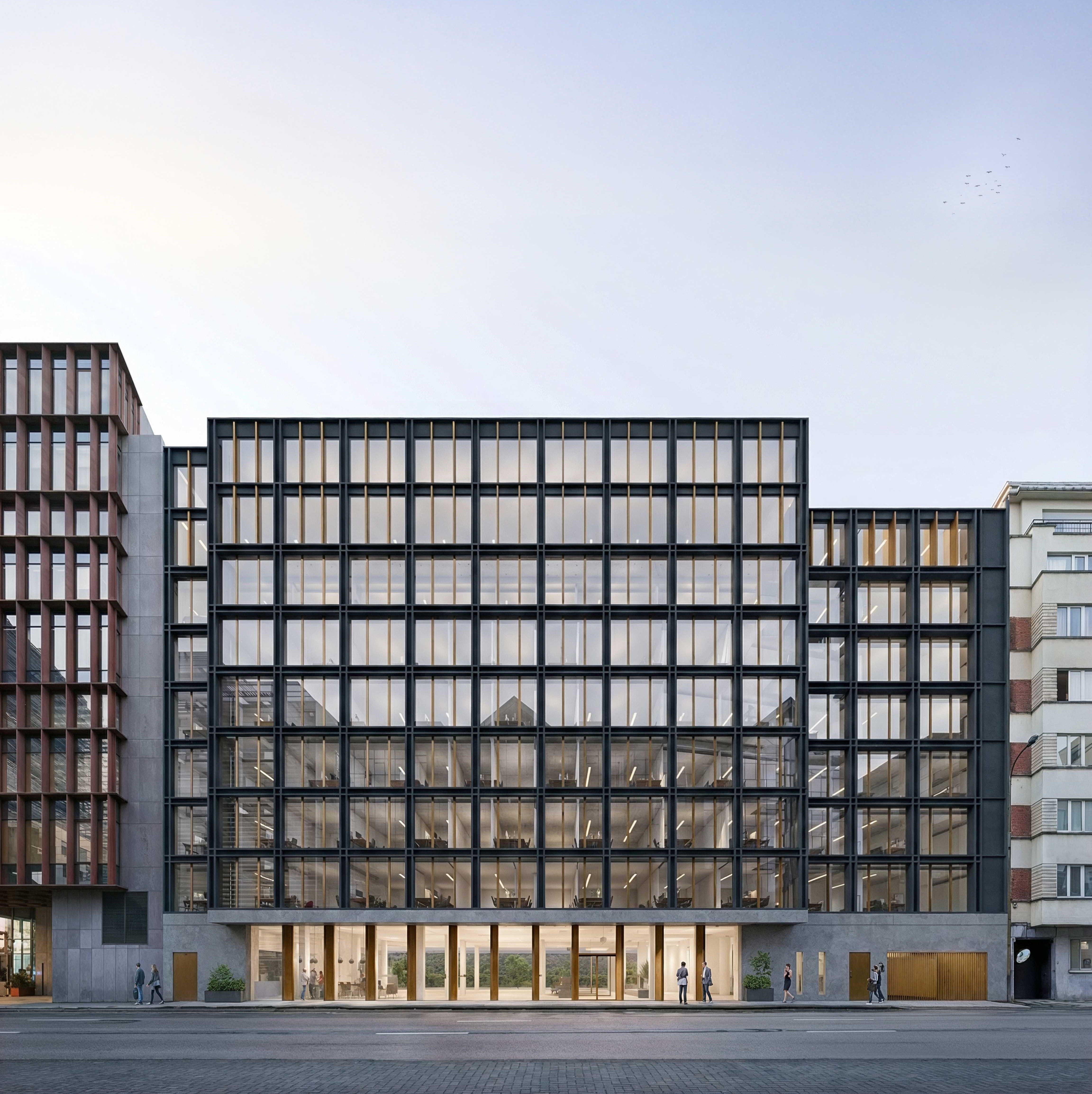
- Réorganisation du rez-de-chaussée et des accès : Le nouveau rez-de-chaussée est implanté au même niveau que le trottoir, dans l’objectif d’activer celui-ci et de créer une réelle interaction entre l’espace public et l’immeuble ;
- Modification du gabarit de l'immeuble avec notamment l’agrandissement des étages types et l’ajout d’un 9ème niveau ;
- ainsi que la démolition/reconstruction partielle du volume en intérieur d’îlot sur 2 niveaux.
Le projet inclut aussi :
- une refonte complète des façades : Les interventions au niveau du volume principal de l’immeuble concernent essentiellement la façade avant (modification du bow-window existant). L’objectif est de remettre un peu d’ordre dans cette façade un peu chaotique ;
- une réorganisation des espaces avec création d’un patio central ;
- une modernisation des techniques et des aménagements intérieurs ;
- ainsi que des ambitions élevées en termes de performances et de durabilité (BREEAM Outstanding, WELL Platinum,...).
Les aménagements extérieurs et fonctionnels sont améliorés avec moins de parkings (réduction du nombre d’emplacements (92 à 49)), un grand local vélos, une terrasse en hauteur et la végétalisation de toutes les toitures.
Le souhait du Maître d'Ouvrage est de maintenir un maximum d’éléments structurels et de réutiliser un maximum de matériaux existants.
En termes de structure, l’enjeu de la durabilité n’étant plus à démontrer de nos jours, et dans la mesure du possible, toutes les nouvelles interventions seront reconstruites en bois (dalles CLT).
C’est une réponse au contexte et à la situation dans laquelle le projet vient prendre place.
Le choix du bois pour cette reconstruction se justifie principalement car il offre les avantages suivants : légèreté, flexibilité, rapidité d'exécution et durabilité.
Le travail sur la façade avant vise à mettre en évidence 3 matérialités/registres différents et contrastés :
- Un socle au rez-de-chaussée, à la fois ouvert et massif, combinant éléments pleins clairs et vitrages avec menuiseries bronze ;
- Des étages intermédiaires (+01 à +08) structurés par une résille métallique rythmée, mêlant trames anthracite et bronze, intégrant un bow-window marquant l’entrée ;
- Et un dernier étage en retrait (+09), traité différemment, en continuité avec la façade arrière et en rappel des matériaux du socle.
Les matériaux utilisés sont durables et de haute qualité, qui vieillissent bien. Ils sont de teintes foncées associés à des éléments plus lumineux de teinte bronze, ce qui donne une matérialité et une cohérence à l’immeuble au sein de l’ensemble de la rue.
La façade arrière, quant à elle, se compose d’une trame régulière composée de parties pleines de teinte claire et de parties vitrées avec des châssis métalliques de teinte bronze.
On trouve également des éléments pleins qui viennent animer l’ensemble de la façade.
La façade arrière se veut plus claire que la façade avant, même si on y retrouve les mêmes teintes que pour le rez-de-chaussée et le dernier étage en retrait.

Project for the major renovation of an office building located at 25 Belliard Street, a building that formerly housed the headquarters of the National Lottery.
Het project beoogt een ingrijpende transformatie van het gebouw om de functionaliteit, de architecturale kwaliteit en de stedelijke integratie ervan te verbeteren:
- Reorganization of the ground floor and access points: the new ground floor is aligned with the sidewalk level, with the aim of activating it and creating a real interaction between the public space and the building;
- Modification of the building’s volume, notably through the enlargement of the typical floors and the addition of a 9th level;
- As well as the partial demolition and reconstruction of the inner block volume over two levels.
The project also includes:
- A complete redesign of the façades: interventions on the main volume of the building mainly concern the front façade (modification of the existing bow window). The objective is to bring more coherence to this rather chaotic façade;
- A reorganization of spaces with the creation of a central patio;
- A modernization of technical systems and interior layouts;
- As well as high ambitions in terms of performance and sustainability (BREEAM Outstanding, WELL Platinum, etc.).
The external and functional layouts are improved with fewer parking spaces (reduction from 92 to 49), a large bicycle storage area, a rooftop terrace, and the greening of all roofs.
The client’s intention is to retain as many structural elements as possible and to reuse as much of the existing materials as possible.
In terms of structure, and considering the importance of sustainability today, all new interventions will, where possible, be constructed in timber (CLT slabs). This responds to the context in which the project is situated. The choice of timber is mainly justified by the following advantages: lightness, flexibility, speed of execution, and sustainability.
The design of the front façade highlights three distinct and contrasting material expressions:
- A ground-floor base that is both open and solid, combining light opaque elements with glazing featuring bronze frames;
- Intermediate floors (+01 to +08) structured by a rhythmic metal grid, combining anthracite and bronze tones, incorporating a prominent bow window marking the entrance;
- And a recessed top floor (+09), treated differently, in continuity with the rear façade and echoing the materials of the base.
The materials used are durable, high-quality, and age well. They feature predominantly dark tones combined with lighter bronze elements, giving the building a strong material identity and coherence within the streetscape.
The rear façade consists of a regular grid composed of light opaque sections and glazed parts with bronze-toned metal frames. Solid elements are also introduced to animate the façade composition. The rear façade is conceived to be lighter than the front façade, although it incorporates the same tones as the ground floor and the recessed top level.
Project voor grondige renovatie van een kantoorgebouw gelegen aan de Belliardstraat 25, een gebouw dat het voormalige hoofdkantoor van de Nationale Loterij huisvestte.
Het project beoogt een ingrijpende transformatie van het gebouw om de functionaliteit, de architecturale kwaliteit en de stedelijke integratie ervan te verbeteren:
- Herinrichting van het gelijkvloers en de toegangen: het nieuwe gelijkvloers wordt op hetzelfde niveau als het trottoir geplaatst, met als doel dit te activeren en een echte interactie te creëren tussen de openbare ruimte en het gebouw;
- Aanpassing van het bouwvolume, met name door de vergroting van de typische verdiepingen en de toevoeging van een 9de niveau;
- Evenals de gedeeltelijke sloop en heropbouw van het binnengebiedvolume over 2 niveaus.
Het project omvat ook:
- Een volledige herwerking van de gevels: de ingrepen aan het hoofdvolume van het gebouw betreffen voornamelijk de voorgevel (aanpassing van de bestaande bow-window). Het doel is om meer samenhang te brengen in deze eerder chaotische gevel;
- Een herorganisatie van de ruimtes met de creatie van een centraal patio;
- Een modernisering van de technieken en de binneninrichting;
- Evenals hoge ambities op het vlak van prestaties en duurzaamheid (BREEAM Outstanding, WELL Platinum, …).
De buiten- en functionele inrichting wordt verbeterd met minder parkeerplaatsen (vermindering van 92 naar 49), een grote fietsenstalling, een dakterras en de vergroening van alle daken.
De wens van de bouwheer is om zoveel mogelijk structurele elementen te behouden en maximaal bestaande materialen te hergebruiken.
Wat de structuur betreft, en gezien het belang van duurzaamheid vandaag, zullen waar mogelijk alle nieuwe ingrepen in hout worden uitgevoerd (CLT-vloerplaten). Dit is een antwoord op de context waarin het project zich situeert. De keuze voor hout wordt voornamelijk gemotiveerd door de volgende voordelen: lichtheid, flexibiliteit, uitvoeringssnelheid en duurzaamheid.
Het ontwerp van de voorgevel legt de nadruk op drie verschillende en contrasterende materialiteiten/registraties:
- Een sokkel op het gelijkvloers, zowel open als massief, met een combinatie van lichte volle elementen en beglazing met bronzen schrijnwerk;
- Tussenliggende verdiepingen (+01 tot +08) gestructureerd door een ritmisch metalen raster, met een mix van antraciet en brons, waarin een markante bow-window de toegang benadrukt;
- En een terugliggende bovenste verdieping (+09), anders vormgegeven, in continuïteit met de achtergevel en met een verwijzing naar de materialen van de sokkel.
De gebruikte materialen zijn duurzaam en van hoge kwaliteit en verouderen goed. Ze hebben overwegend donkere tinten, gecombineerd met lichtere bronzen accenten, wat zorgt voor een sterke materialiteit en samenhang binnen het straatbeeld.
De achtergevel bestaat uit een regelmatige structuur met lichte volle delen en beglaasde delen met metalen raamprofielen in bronstint. Daarnaast zorgen enkele volle elementen voor extra dynamiek in de gevel. De achtergevel is lichter opgevat dan de voorgevel, hoewel dezelfde tinten terugkomen als bij het gelijkvloers en de terugliggende bovenste verdieping.


